Government & Nonprofit Solutions | Deployable Shelter & Site Infrastructure
Designed for temporary, relocatable, and project-specific deployments. Permitting, occupancy classification, site installation, accessibility, utility, and other requirements are determined by the applicable authority having jurisdiction (AHJ).

THE CASE

Most emergency and transitional shelter procurement means waiting. Waiting for site approval, waiting for conventional construction, and waiting for funding cycles to align with need. BaseBox is designed to shorten the physical deployment portion of that process.
Steel-framed, fully insulated, and designed for rapid deployment, each BaseBox ships flat and unfolds onsite. A small crew can erect the structure quickly, with final setup including roof installation, weather sealing, anchoring or other approved site restraint, and applicable utility connections.
BaseBox can be configured for shore power or solar/battery operation, making it suitable for prepared sites ranging from existing campuses and paved lots to remote field locations. The appropriate foundation or anchoring method, utility connections, permits, inspections, and licensed trade work are determined for each deployment based on the site, intended use, and local AHJ requirements.
Priced for real-world procurement budgets, BaseBox combines rapid deployment with durable steel construction, non-combustible mineral-wool insulation, and safety-focused standard features.
Whether you're responding to an emergency, creating transitional shelter capacity, supporting a workforce deployment, or adding private space to an existing facility, BaseBox gives programs a relocatable structure that can be deployed, reassigned, stored, and reused as needs change.

BaseBox 72
From $10,399 | Bulk pricing available
-
Compact private shelter configuration for 1–2 occupants
-
Accommodates up to two single beds or one double bed
-
30-amp electrical system
-
Wide, low-threshold entry
-
Large operable emergency-egress window in shelter configuration
-
Structural unfolding and erection in minutes
-
Occupancy and project requirements subject to AHJ approval

BaseBox 152
From $12,950 | Bulk pricing available
-
Larger private or shared shelter configuration
-
Accommodates up to four single beds or two double beds, depending on approved layout
-
Steel-frame, insulated construction
-
Wide, low-threshold entry
-
Configurable for accessibility requirements
-
Rapid structural deployment
-
Occupancy and project requirements subject to AHJ approval

BaseBox BL
$36,500 | Pairs with shelter units
-
Trailer mounted mobile bathroom and laundry support unit
-
Designed for relocatable deployment rather than permanent anchoring
-
ADA-oriented bathroom layout
-
Shower, toilet, vanity, washer and dryer
-
Tankless water heating
-
50-amp electrical service
-
Connect to approved site utilities or configured onboard water/waste systems
-
Pairs with BaseBox shelter deployments and other temporary sites
Site placement, accessibility, plumbing, gas, electrical, utility, health and other requirements are determined by the applicable AHJ and project conditions.
FULL SITE DEPLOYMENT
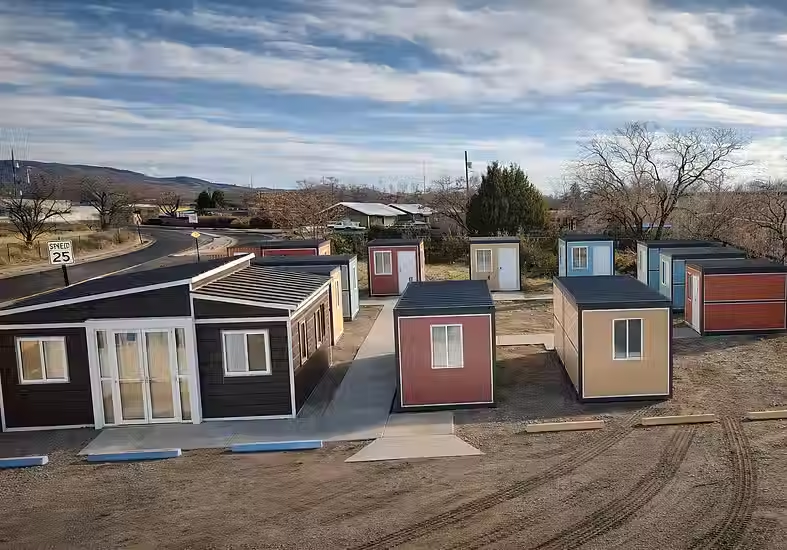
BaseBox units are designed to work together as a flexible site system. Pair shelter units with a BaseBox BL for sanitation and laundry support, and configure additional units for staff, storage, administrative, or program needs. Units ship flat, deploy rapidly, and can be relocated, reassigned, or stored as programs evolve.
Site infrastructure requirements depend on the deployment. BuildSwift works with the purchasing agency, project team, and AHJ to identify applicable site, foundation/anchoring, utility, fire, accessibility, occupancy, permitting, and inspection requirements.

Each deployment is project-specific. BaseBox can be configured for these applications where approved by the applicable agencies and AHJ.
USE CASES


EMERGENCY SHELTER RESPONSE
NON-CONGREGATE TRANSITIONAL HOUSING PROGRAMS
DISASTER RELIEF AND RAPID DEPLOYMENT


WORKFORCE AND SEASONAL HOUSING
SANITATION INFRASTRUCTURE FOR EXISTING SITES
INDOOR SHELTER PILOT PROGRAMS USING EXISTING FACILITIES
UNMATCHED PERFORMANCE
Why Choose BaseBox
SPEED

7–10 minutes for structural deployment.
BaseBox unfolds rapidly, dramatically reducing onsite structural assembly. Final weather sealing, anchoring, utilities, inspections, furnishing, and site activation follow as required by the project and AHJ.
DURABILITY
Steel construction. Non-combustible materials. Built for repeated deployment.
Steel frame and exterior surfaces with non-combustible mineral-wool insulation. Designed for durability, relocation, storage, and reuse.
ACCESSIBILITY
Designed with accessibility in mind.
Wide, low-threshold entries are standard, with ramp and site-access options available. Final accessible-route, entrance, interior-layout and site requirements are established for the particular deployment in coordination with the project team and AHJ.
SCALABILITY
Scalable — Order one unit or one hundred.
Free site delivery for orders of 10 or more. Pricing scales with quantity. Units can be configured around approved shared sanitation and site infrastructure to create project-specific community layouts.
FLEXIBILITY

Relocatable — Deploy, redeploy, reassign.
Relocatable & Storable — Move by standard flatbed. Deploy, redeploy, reassign as your program evolves. When not in use, units fold flat to just 1 foot tall and stack — storing a large inventory in a fraction of the footprint of any comparable structure. Unlike conventional site-built infrastructure, BaseBox can remain an agency asset after the original deployment ends — relocate it to another program, reconfigure the site, or fold and store units for future response needs.
Government and nonprofit deployments may be classified differently depending on duration, occupancy, configuration, site conditions and jurisdiction. Temporary-structure or temporary-use approval may be available for some projects, while others may require modular, building, fire, accessibility, electrical, plumbing, mechanical, zoning or other approvals.
BuildSwift works with the project owner and local authority having jurisdiction to identify the appropriate approval pathway before deployment.